Tips
You do not need to know all these details. This is only shown for educational purposes.
Mnemonic Phrase or Seed Phrase
The website Mnemonic Code Converter
is a useful tool for experimenting with seed phrases. We'll use it to illustrate the key types supported by Zkool.
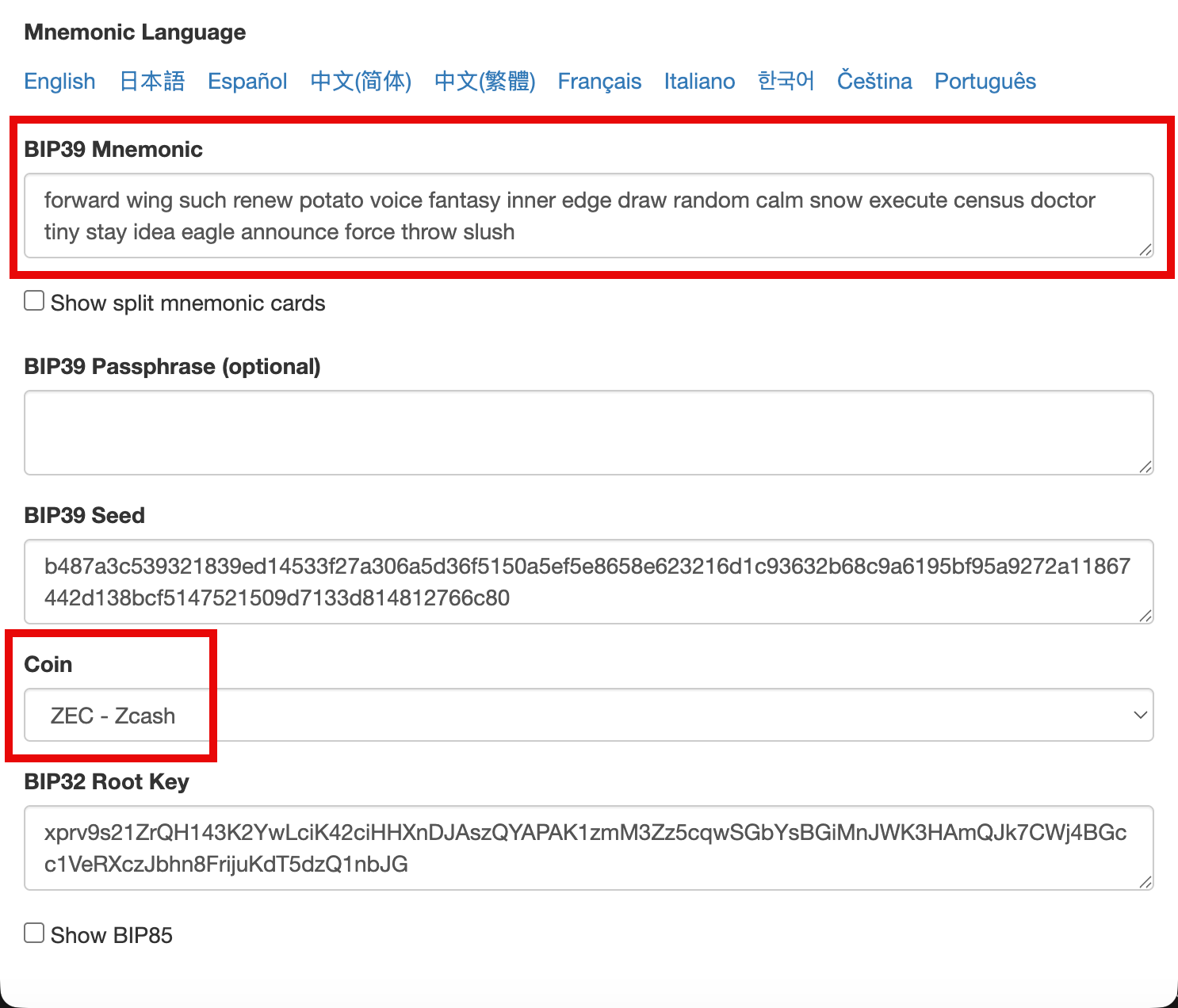
Zkool supports 12, 15, 18, 21, 24 word seed phrases[1]. 3, 6, 9 word are deemed too insecure. We recommend using 24 word seed phrases. Zkool will only generate this type of seed phrase.
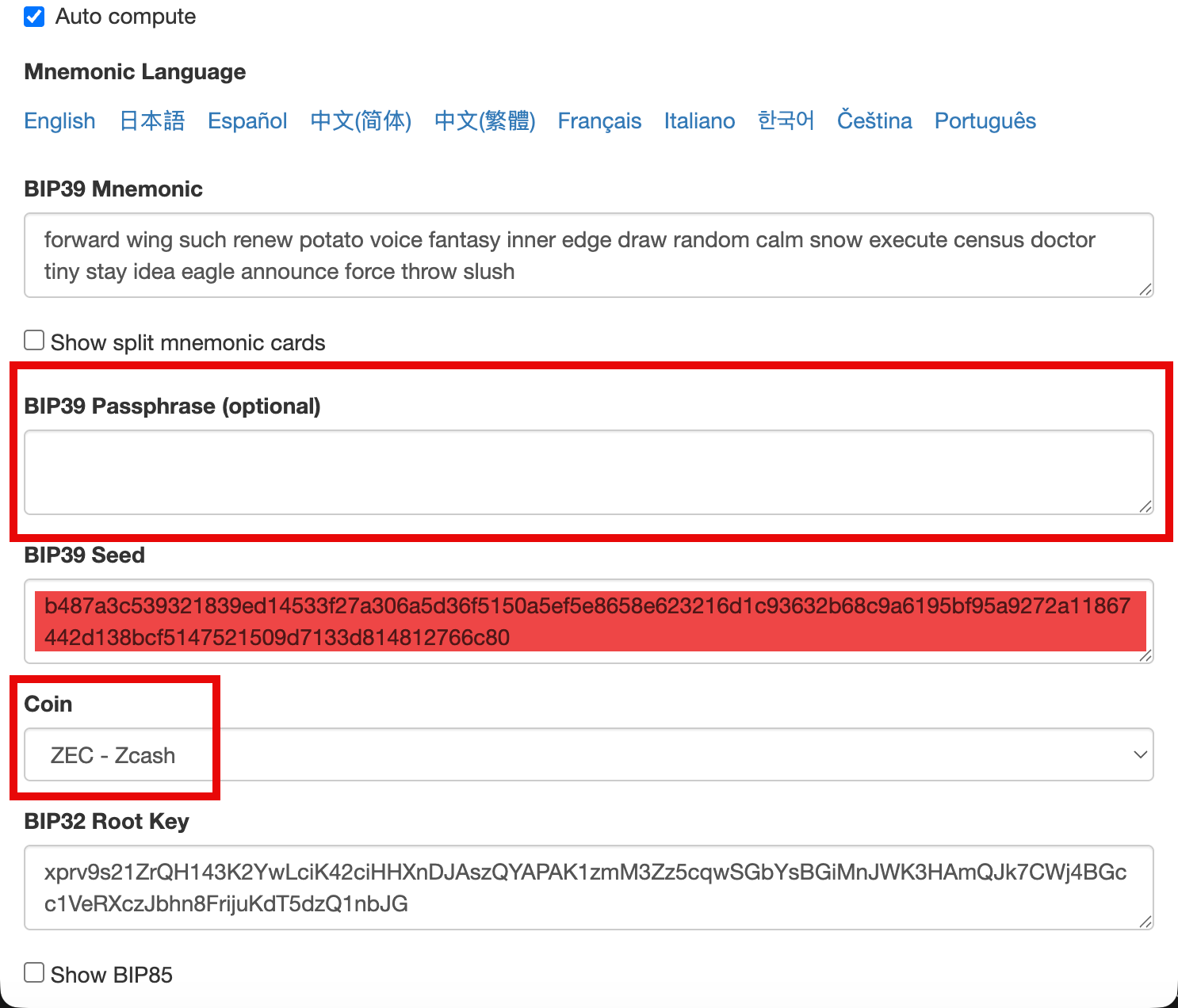
The passphrase can be complemented with an arbitrary password (or sentence) of your choice[2]. This gives the BIP 39 Master Seed.
Transparent Extended Key
Make sure you select ZCASH as the coin.
When you scroll down the page, you will see a form about BIP 44 derivation path.
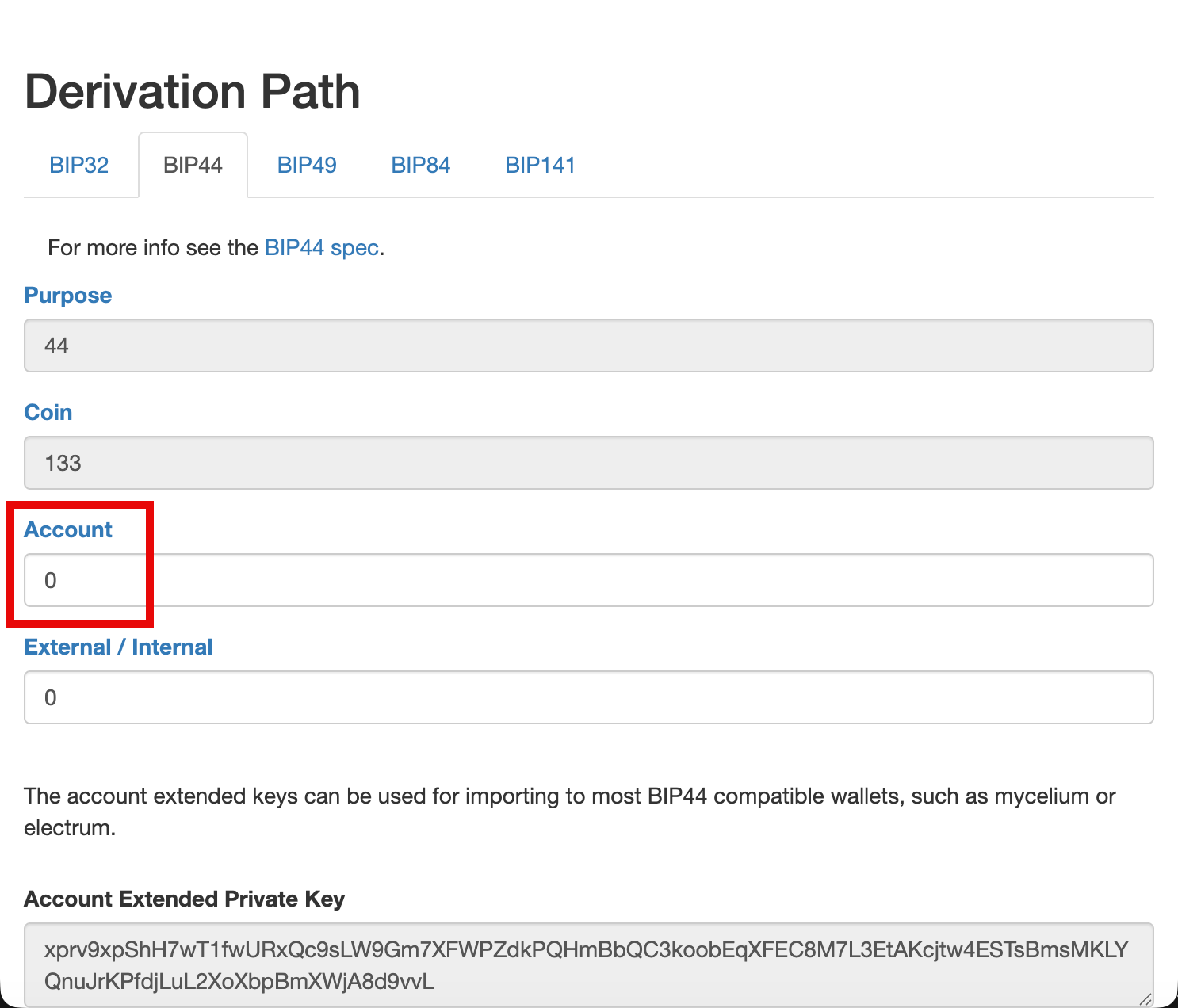
The "purpose" is set to 44 which is BIP-44 and the coin is set to 133 (Zcash was assigned 133)[3].
The remaining options are "Account" and "External/Internal".
Account is the Account Index in Zkool. External should be left to 0 for imported accounts. Other values are used internally for change and temporary addresses.
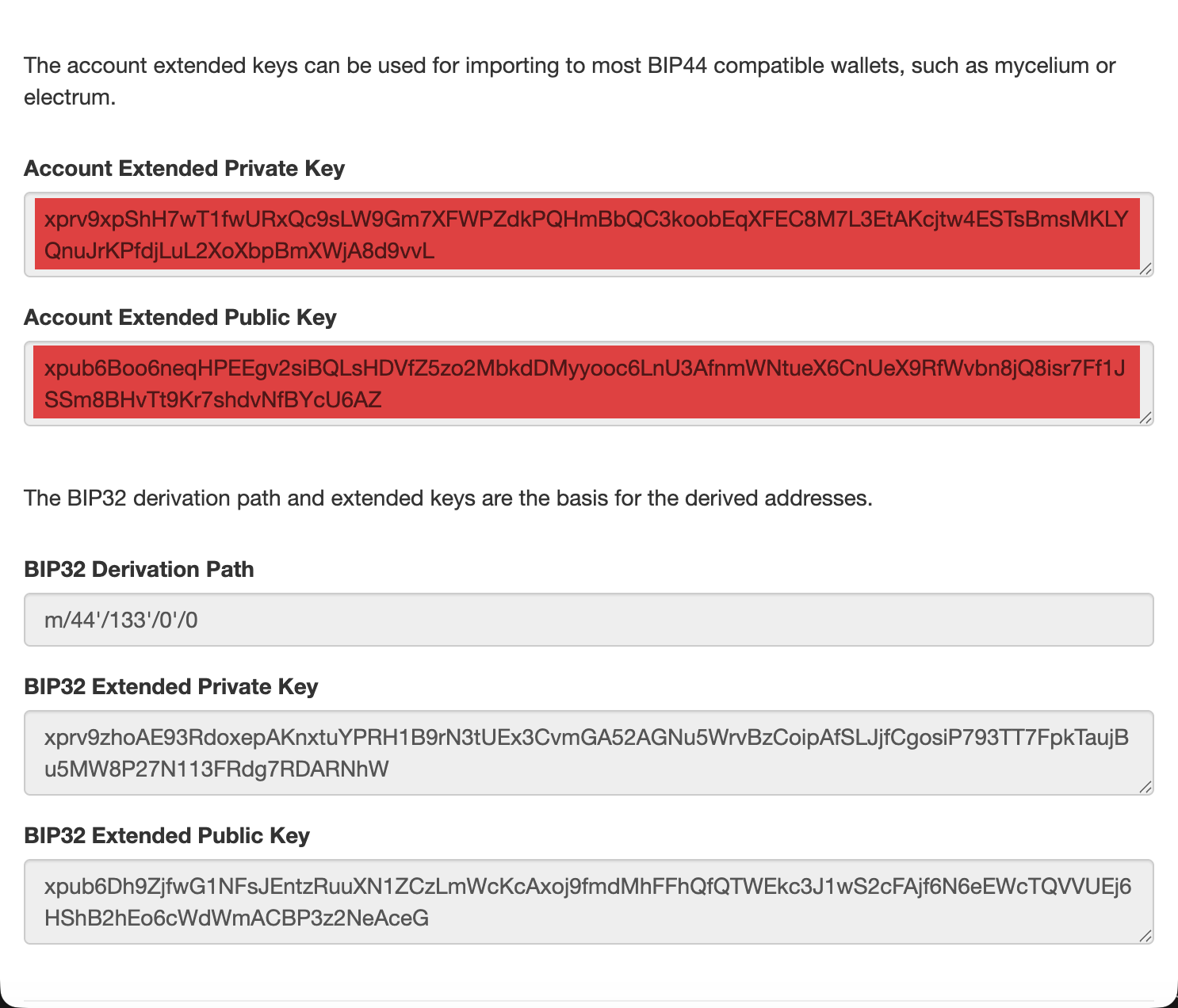
This gives you the Account public and private extended keys. These keys allow you to create the primary transparent address and generate additional addresses for the change and for better anonymity.
For example, a seed phrase of "forward wing such renew potato voice fantasy inner edge draw random calm snow execute census doctor tiny stay idea eagle announce force throw slush" with no password and account index 0 gives "xprv9xpShH7wT1fwURxQc9sLW9Gm7XFWPZdkPQHmBbQC3koobEqXFEC8M7L3EtAKcjtw4ESTsBmsMKLYQnuJrKPfdjLuL2XoXbpBmXWjA8d9vvL" and "xpub6Boo6neqHPEEgv2siBQLsHDVfZ5zo2MbkdDMyyooc6LnU3AfnmWNtueX6CnUeX9RfWvbn8jQ8isr7Ff1JSSm8BHvTt9Kr7shdvNfBYcU6AZ".
The xprv key allows Zkool to derive secret keys and addresses. The xpub keys only allows the derivation of addresses.
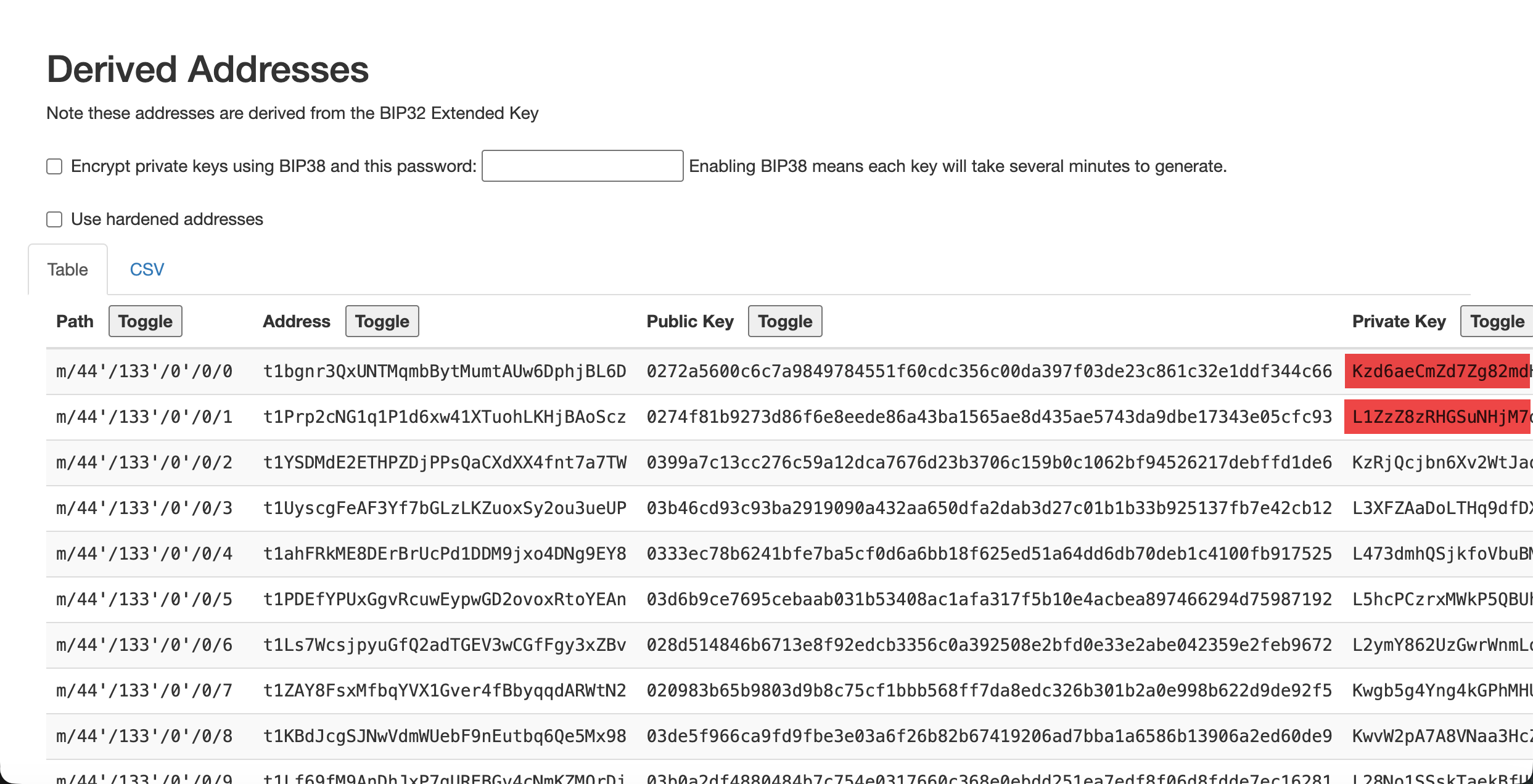
xprv keys are derived further into secret keys and addresses, using the external/adddress index path.
Important
Transparent "diversified" addresses have distinct secret keys. They have to be queried separately. This is not a big issue because the server builds a lookup index, unless hundreds of addresses are probed.
This is BIP-44, the standard for transparent address derivation.
Private Key
Zcash wallets that support transparent addresses sometimes derive a single address and export its private key directly. Such wallets do not implement address rotation.
A Zcash private key begins with K or L.
Shielded Extended Key
Shielded Address derivation works completely differently.
Shielded Keys are derived using another standard specific to Zcash: ZIP-32. It covers both Sapling and Orchard keys.
ZIP-32 begins with a Master Seed derived by BIP-39, i.e. it is the same Master Seed from the mnemonic and passphrase.
Then Sapling derives expanded spending keys[4] from the seed and the account index[5].
The Sapling key has an external encoding. It begins with secret-extended-key-main. Zkool can import them.
Orchard derives a spending key too. It has different components than Sapling but has the same capabilities. Orchard has an encoding too: secret-orchard-extsk-main but these are not supported by Zkool[6].
Viewing Keys
A public blockchain or transparent address exposes the complete history of transactions. With a shielded address, the history is encrypted.
There is a type of keys, the (full) viewing keys, that allow the decryption of the transactions related to their associated address.
Sapling has legacy viewing keys: they begin with zxviews. Orchard has no specific encoding for their viewing keys but one can use Unified Viewing Keys. They begin with uview.
Unified FVK and Addresses
Starting with Orchard, addresses and viewing keys do not have their own character encoding like Transparent and Sapling do. Of course, they still have a binary representation. For instance, an Orchard address is represented by 43 bytes as specified in the section Orchard Raw Payment Addresses, Protocol Documentation.
Orchard and future pool addresses use the Unified Address encoding. It is essentially a container of binary addresses (called receivers). It is similar to how MP4 files can have different types of video stream (H264, H265, etc). A UA can have one instance of one of the currently active pools (Transparent, Sapling and Orchard), ie a sapling and an orchard receiver but not two orchard receivers.
The same applies to viewing keys. A Unified Full Viewing Key (UFVK) can also contain one instance of a viewing key for one of the active pools[7].
Zkool supports any type of UFVK[8].
Zkool also supports Unified Incoming Viewing Keys (uivk). An account restored from one only sees the payments it receives: it cannot see its spends or its change, and cannot spend. The Viewing Keys page of an account exports either kind (see Edit an Account).
Important
There are more types of keys such as outgoing viewing keys, unified secret keys, etc. At the moment, there are not used much in production and Zkool does not support them.
Tips
You can restore a very old account (even before Sapling activation), as far back as the genesis block.
Also called mnemonic phrases. ↩︎
However, not every hardware wallet vendor supports them, or they limit it to a password. ↩︎
If not, check that you set ZCASH as the coin in the dropdown box. ↩︎
a combination of the authorization spending key ask, nullifier key nk, output viewing key ovk and diversifier key dk. ↩︎
ZIP-32 supports non-hardened and hardened derivation, but in practice we only use the hardened derivation. ↩︎
At this moment, we don't have support for parsing these keys. ↩︎
Transparent pool uses xpub, Shielded pools use Full Viewing Keys. ↩︎
Sapling UFVK also has its own native encoding. ↩︎